LeadBoxer Platform: EU-Hosted Behavioral Data Layer for B2B SaaS
Centralize web, email, and product behavior into an EU-hosted layer that links anonymous and known accounts and scores intent.

If you can’t see buyer activity across your site, emails, and product, you miss timing. I’d sum up LeadBoxer this way: it pulls those signals into one EU-hosted layer, links anonymous and known activity, scores intent, and sends the result into the tools your team already uses.
Here’s the short version:
It tracks behavior in real time across websites, email, and product events
It links anonymous visits to companies and later ties them to contacts
It adds firmographic data and intent scores so teams can rank accounts
It pushes data into CRM, marketing tools, and product flows
It keeps data in the EU, which can help with GDPR review, procurement checks, and residency rules
In plain terms: instead of scattered events sitting in separate systems, you get one view of account activity that sales, marketing, product, and RevOps can act on.
A few points stand out to me:
Many B2B SaaS teams already have the raw data, but it stays split across tools
Static scoring often focuses on fit, not current behavior
Product events like trial starts or feature use often never reach the CRM
EU hosting matters when legal, security, and procurement teams review data flow
For teams running account-based sales or PQL motions, that means fewer blind spots and better timing on outreach, nurture, and in-app prompts.
Area | What LeadBoxer Does | Why It Matters |
|---|---|---|
Data collection | Tracks web, email, and product events | Puts activity in one place |
Identity | Matches visits to companies and contacts | Makes anonymous traffic more useful |
Scoring | Combines behavior with ICP fit | Helps teams rank accounts |
Activation | Sends signals to CRM and workflow tools | Turns data into action |
Hosting | Keeps infrastructure in the EU | Helps with residency and review needs |
I see this article as a practical look at one main idea: how to turn scattered behavior into usable account signals without adding more tool sprawl.
The Problems LeadBoxer Solves for B2B SaaS Teams
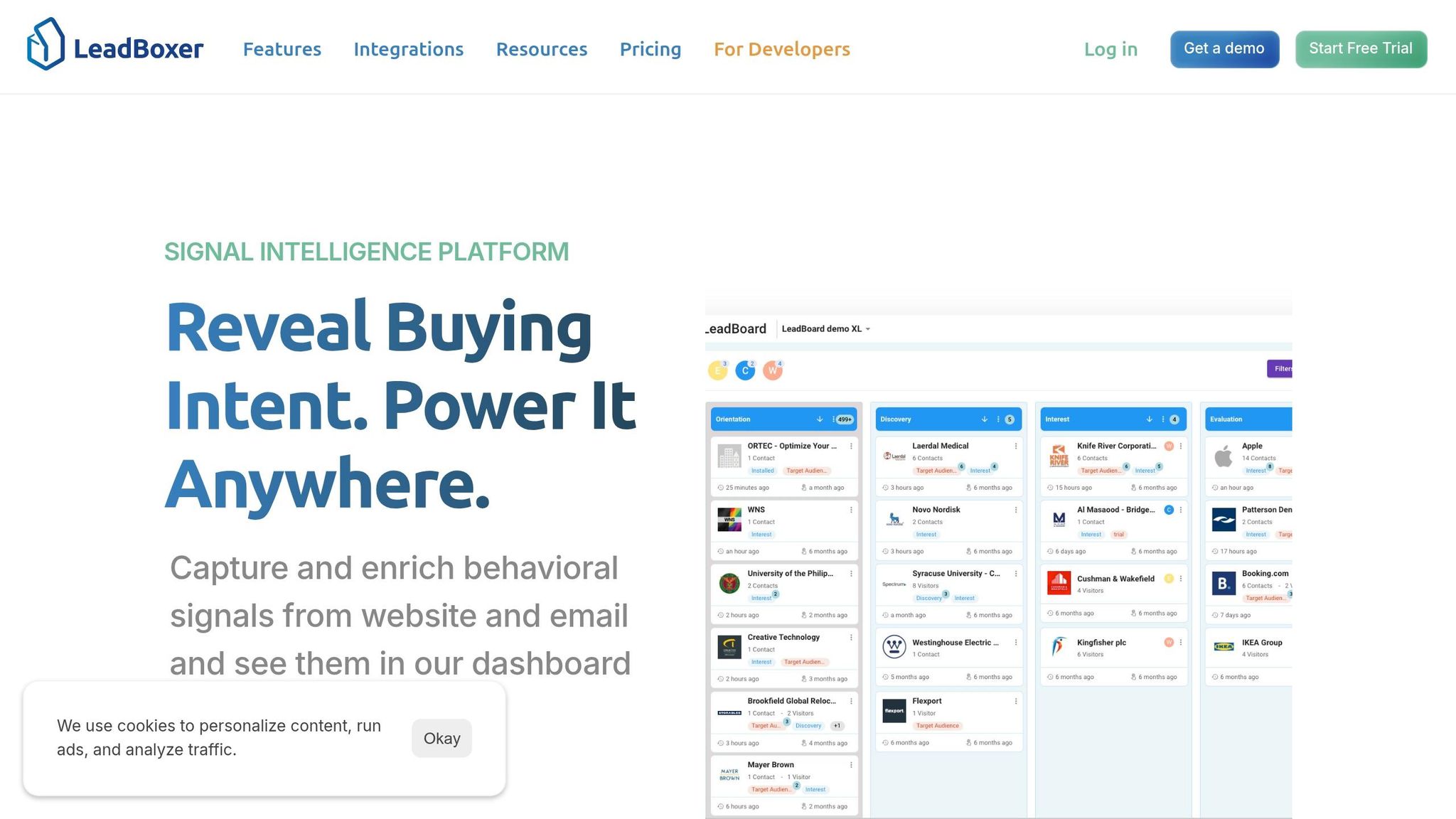
Anonymous visits and siloed product data create blind spots
A lot of high-intent traffic never turns into a form fill. Someone can spend time on your site, check pricing, read product pages, and still leave without sharing a single detail. To sales and marketing, that visit is basically invisible.
The issue gets worse when product events are locked away in backend systems. Events like trial_started, feature_used, or subscription_upgraded may exist in your database, but they never make it into the CRM or marketing automation tools where teams spend their day. So marketing can see website activity but not product usage. Sales can see CRM records but not live engagement. And nobody gets the full picture of what an account is doing. That leaves both teams without a dependable view of account intent.
Static lead scoring misses real buying intent
Most lead scoring models are built around the easiest fields to collect: job title, company size, industry, and form fills. That tells you who the lead is. It doesn't tell you what they’re doing right now.
Without live behavioral signals, scoring models create a lot of noise. A sales rep might get an alert based on an old action while another account is actively trying a feature and engaging across several touchpoints. These models also miss account-level intent, where more than one stakeholder interacts over time. Without behavioral data in the mix, scoring stays descriptive instead of predictive.
EU privacy and data residency requirements slow adoption
For B2B SaaS teams that serve European customers, or teams with strict internal data governance rules, behavioral tracking can slow deals down before a tool is even approved. Legal teams often need to review data residency and confirm GDPR compliance before procurement can move ahead.
The main blockers usually come down to a few things:
Cross-border data transfers - slows legal review and procurement; LeadBoxer is 100% EU-hosted (Hetzner, Germany)
GDPR compliance - compliance risk and consent-review friction; LeadBoxer uses a GDPR-native architecture
Data isolation - risk of cross-tenant data exposure; addressed through tenant isolation and scoped API keys
EU hosting helps deal with these concerns at the infrastructure level. In practice, these limits shape how teams vet behavioral tools before rollout.
How the LeadBoxer Platform Works
LeadBoxer closes those gaps by pulling website, email, and product behavior into one stream.
Tracking website, email, and product events in real time
LeadBoxer tracks activity in two main ways: a lightweight JavaScript snippet on your web properties and an event-based API for product and backend systems. The Lead Pixel records first-page activity and assigns each visitor a first-party cookie ID that stays with them across sessions.
It tracks page views, clicks, form fills, downloads, email opens, link clicks, and product events like trial starts, onboarding completion, and feature use. Server-side tracking also records milestones when browser settings or ad blockers stop client-side events.
That stream starts to matter once LeadBoxer connects identities to companies and contacts.
Turning anonymous traffic into company and contact intelligence
LeadBoxer uses IP and network intelligence along with cookie-based identifiers to match anonymous sessions to company-level records. If multiple visitors come from the same company domain or network, the platform groups that activity under one account even before anyone logs in or submits a form.
Once a visitor clicks a tracked email link, fills out a form, or logs in, LeadBoxer ties that person to earlier anonymous activity and builds one timeline for both the contact and the account. So if a Director-level buyer keeps returning to security and integration pages, LeadBoxer can match that activity to a company, enrich the record, and surface it to sales before a form fill happens.
Adding enrichment and intent scoring to build usable signals
Once identity is resolved, LeadBoxer can enrich the record and score the account.
Raw events become more useful when you add firmographic and contact context. LeadBoxer enriches records with firmographic details such as company name, industry, size, location, and revenue range, plus contact-level details like role, seniority, and department.
LeadBoxer scores blend behavior signals like recency, frequency, and event type with ICP fit, including industry, company size, region, and seniority. For example, repeated pricing-page visits, completed onboarding, and activity from several contacts at the same time can increase an account score. Scores can also be split into PQL signals driven by in-app behavior and MQL signals driven by website and content engagement, with an account-level score that keeps top-priority accounts at the top.
LeadBoxer then sends unified identities, enriched event streams, and lead or account scores into CRM and workflow tools. The end result is a behavioral data layer teams can route into CRM, marketing automation, and in-app workflows.
What Teams Get From LeadBoxer and How They Use It
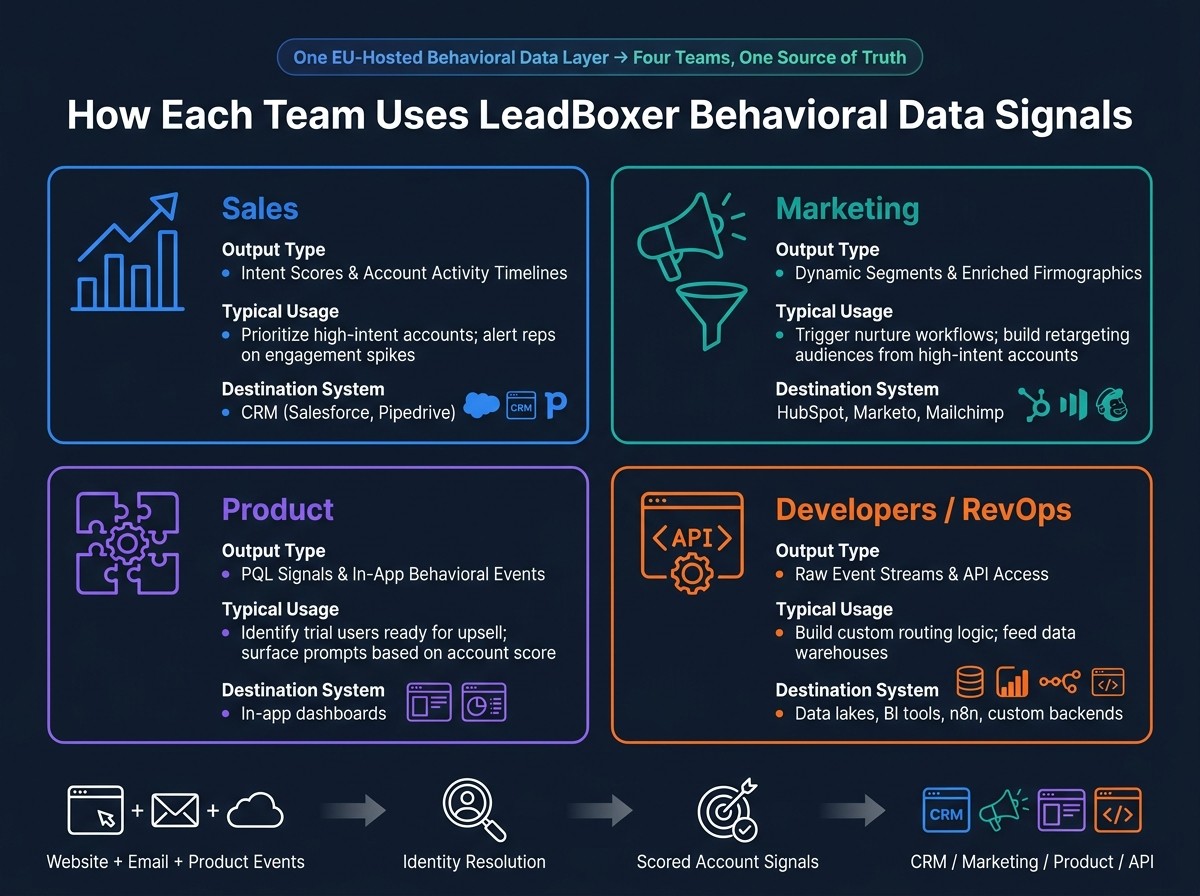
LeadBoxer: How Each Team Uses Behavioral Data Signals
Structured profiles, event streams, and lead or account scores
Once LeadBoxer resolves identity and scores intent, teams can work with that data in three main forms: profiles, event streams, and priority signals.
That gives teams more than a raw list of visits. It gives them a way to see who engaged, what they did, and how much that activity matters.
LeadBoxer also builds dynamic segments based on recency, engagement depth, engaged contacts, and visits to pricing, demo, or integration pages. Those segments can trigger sales alerts, CRM syncs, or nurture flows. From there, the same signals can move into sales, marketing, product, and workflow automation.
Delivery into CRM, marketing automation, and in-app workflows
Scores and enriched firmographics can be written into CRM fields in Salesforce, HubSpot, or Pipedrive, so reps can prioritize accounts based on live intent.
Marketing teams can connect behavioral segments to HubSpot, Marketo, or Mailchimp to trigger nurture tracks, suppress low-intent contacts, or tailor messaging based on page activity. If someone spends time on a pricing page, for example, that signal can shape the next email or campaign touch.
Product and growth teams can surface a talk-to-sales prompt when an account score crosses a set threshold. They can also route a trial user into a higher-touch onboarding flow when usage milestones and firmographic fit line up.
Developers and RevOps teams have a more direct path too. They can pull raw event streams through the REST API, send them into data warehouses, or build custom routing logic with webhooks or n8n nodes.
Core B2B SaaS use cases with clear output value
The most useful use cases come down to timing and account-level visibility.
Say a target account lands on a pricing page. LeadBoxer can update the account score, push a CRM update, and send a sales alert to the right rep. That helps sales step in while interest is still high, not days later when the moment has passed.
For product teams running a PQL motion, LeadBoxer can enrich in-app usage milestones - like completing onboarding or hitting a feature usage threshold - with company size, industry, and ICP fit. So instead of seeing only that a user took action, the team can see whether the account looks ready for sales.
Role | LeadBoxer Output | Typical Usage | System Where Consumed |
|---|---|---|---|
Sales | Intent scores & account activity timelines | Prioritizing high-intent accounts and alerting reps on engagement spikes | CRM (Salesforce, Pipedrive) |
Marketing | Dynamic segments & enriched firmographics | Triggering nurture workflows; building retargeting audiences from high-intent accounts | HubSpot, Marketo, Mailchimp |
Product | PQL signals & in-app behavioral events | Identifying trial users ready for upsell; surfacing prompts based on account score | In-app dashboards |
Developers / RevOps | Raw event streams & API access | Building custom routing logic and feeding data warehouses | Data lakes, BI tools, n8n, custom backends |
These outputs matter most when teams can decide where the data lives and how it moves.
EU-Hosted Setup, Governance, and Key Takeaways
Why EU hosting matters for procurement and governance
Once LeadBoxer turns behavior into scores and alerts, governance shapes how fast teams can put that data to work. If behavioral data stays in EU infrastructure, legal and security reviews often move with less back-and-forth. LeadBoxer runs in ISO 27001-certified data centers and includes tenant isolation and scoped API keys by default, which gives security teams a setup that already lines up with common enterprise requirements. In plain English: keeping data in-region can ease transfer reviews, trim procurement friction, and reduce buyer concern.
Still, EU hosting isn't a compliance pass. Teams still need a legal basis for processing, up-to-date cookie disclosures, and a clear internal owner - usually RevOps or a data team - to handle configuration and governance.
Key takeaways for SaaS, product, and developer teams
LeadBoxer turns anonymous and known behavioral activity across websites, email, and product surfaces into structured revenue signals. That includes visitor identification, firmographic enrichment, intent scoring, and API-ready outputs that can flow into CRM fields, marketing automation segments, and in-app workflows.
The EU-hosted model can make adoption easier because it cuts transfer complexity and fits data residency expectations that EU entities and global organizations often enforce. But governance still comes down to team setup. Lawful bases, retention limits, role-based access, and privacy disclosures remain the team's job, not the infrastructure's. When those controls are in place, the same signals can flow cleanly into sales, marketing, and product workflows.
FAQs
What data do I need to send into LeadBoxer?
You can send behavioral and contextual data through client-side scripts or server-side API calls.
Common inputs include:
IP addresses for company identification
Email addresses for contact stitching
Events like page views, clicks, form submissions, and logins
You can also send backend events, such as subscription upgrades or billing status.
With LeadBoxer.track and LeadBoxer.identify, you can attach properties or user identifiers to sessions. That gives you more accurate data enrichment and helps workflows fire at the right time.
How does LeadBoxer connect anonymous visitors to accounts?
LeadBoxer identifies anonymous visitors at the account level by combining reverse IP lookup, browser fingerprinting, and cross-session cookie matching.
Here’s the basic idea: it checks a visitor’s IP address against a global database, then returns firmographic details such as company name, industry, company size, and revenue.
When a visitor later shares an identifier, like an email address or a login event, LeadBoxer links those earlier anonymous visits to the known lead. That way, it builds one behavioral profile that pulls activity together across sessions and devices.
What does EU hosting actually help with?
EU hosting helps meet GDPR privacy and data residency requirements by keeping data processing inside the EU. That matters for teams that need user data handled under EU rules, not bounced across regions without clear control.
It also gives companies a privacy-first setup, with clear data models and retention policies. In plain terms, you can see what data is stored, how it moves, and how long it stays there.
On top of that, EU hosting supports governance and day-to-day security. Features like tenant isolation and API key scoping help B2B SaaS companies keep accounts separated and access tightly controlled. The result is a compliant foundation for collecting and enriching behavioral data without making privacy an afterthought.
Related Blog Posts
Build on the LeadBoxer Platform
APIs for tracking, company identification, enrichment and scoring. The first 25,000 credits are free.